


Vineyards
Our vineyards are guardians of a unique landscape and knowledge that continues to be passed down through generations
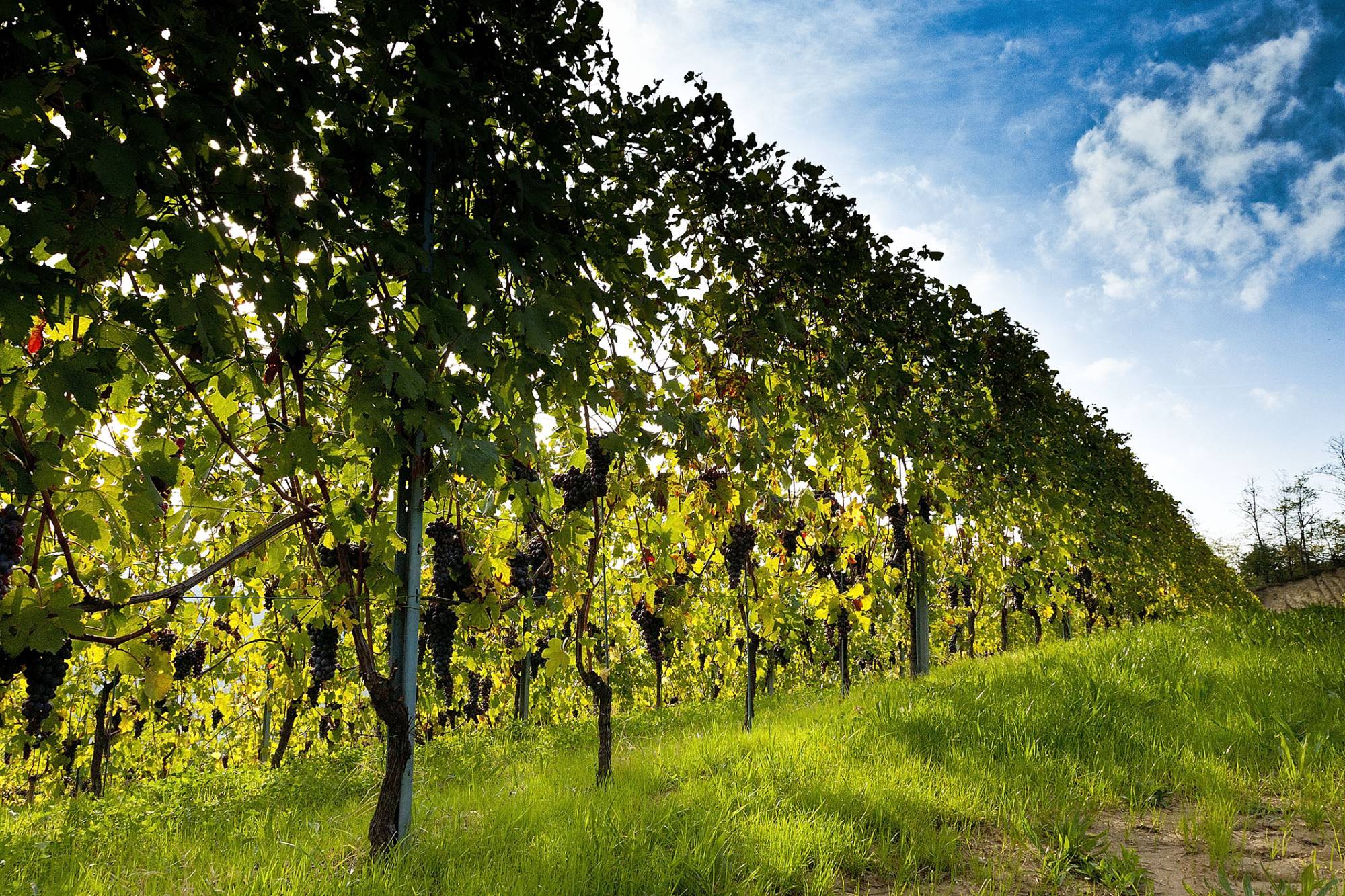
Our vineyards surround La Fusina, and monitoring the vineyards and the health of the vines is an opportunity to connect with our land, to observe the changes of the seasons and perceive the uniqueness of each plot, which has its own characteristics and contributes to defining the identity of our wines.
Right at the beginning of the road leading up to the farmhouse, there is a large plot that occupies the entire hillside.
Here we produce Dogliani Superiore in the historic vineyard of our estate, dating back more than 90 years, the Langhe Nebbiolo, and, in the slightly younger vineyards we planted about 25 years ago, the Langhe Barbera.

In Dogliani we mainly cultivate Dolcetto, destined for both Dogliani DOCG Santa Lucia and Langhe Dolcetto.
Near the winery we find our Pinot Nero and Chardonnay vineyards, from whose grapes our Alta Langa is born.
We also have two vineyards in Monchiero, which give birth to our Barbera d’Alba, and three in Monforte d’Alba, dedicated respectively to Barolo, Langhe Nebbiolo, and Barbera d’Alba.
Finally, we also cultivate a small parcel of Sauvignon, located below the house, which completes the mosaic of our wines.

Some vineyards tell particular stories
The most significant is that of Dogliani Superiore DOCG San Luigi Cavagnè, which comes from an ancient story.
The first owner of that vineyard worked as a cavagnè, a Piedmontese term for someone who worked with wicker to make baskets (cavàgne).
Hence the name, linked not to the place but to the life and work of the person who first cultivated it.
It is also one of the oldest vineyards on the estate, over 90 years old.

Ours is a concrete philosophy, perhaps not very romantic, but deeply honest.
Respect, common sense, responsibility
We are SQNPI certified, but what matters most are the daily choices: we work in the least invasive way possible, reducing treatments to a minimum and intervening only when necessary.
We do not use herbicides either around the winery or in the vineyards. Ours is viticulture based on common sense, which does not follow ideologies but responsibility: if a vintage requires it, we intervene more, without extremism.

For us, sustainability means finding a balance between respect for the environment and economic balance, without forcing or rhetoric
In the winery we seek every day a meeting point between innovation and tradition: innovation is necessary, especially in technologies and processes, but without losing our identity. We do not believe in “wine like it used to be” if that means sacrificing cleanliness and product quality.
The goal is to obtain harmonious, sincere, and readable wines, capable of expressing territory and style. Continuous dialogue with the oenologist is a fundamental part of the work, but without standardization: each wine must maintain its own identity.
This is also why every harvest is different and unrepeatable. Our task is not to standardize it, but to enhance it, because each vintage tells a new nuance of our work and our territory.

Pruning
The training system we use is called guyot. A cane is chosen from which buds will emerge that will in turn give life to fruiting shoots.
The average pruning for Dolcetto is around eight buds, but the choice must be made based on the strength of the plant, which can be assessed by observing the development of the shoots in the previous year.
This long operation lasts throughout the winter until the beginning of spring. This work determines the entire vintage, so it requires maximum attention and knowledge of the plant.
Cane removal
After pruning, the canes not selected, called vine shoots, are cut, but not lost. In fact, they will either be used to fertilize the soil during shredding, or some are collected in bundles that we then use to heat the oven where we make the bread we eat daily.
Desuckering
It is carried out in spring-summer and is also called green pruning, as it is performed on the green parts of the plant.
Shoots that emerge from the fruiting cane but are sterile and not needed for the following year’s pruning are removed. In addition, all double shoots are eliminated, already performing a first thinning.
The purpose of this operation is to prevent the canopy from becoming too dense. It should be carried out as early as possible (while budding is still in progress) when the shoots are still tender.
Training
Toward the beginning of July, the vineyard shoots are bent onto the top wire, containing their growth. In our case, shoots that exceed the top wire are cut with a machine—this operation is called topping.
Leaf removal
For Dolcetto, a very delicate grape, this work is important and must be done with great care. In fact, you need to remove the leaves inside the row to avoid humidity, but you must leave the outer leaves that provide shade and protection to the clusters, especially in vineyards exposed to the hottest sun.
Cluster thinning
With cluster thinning, part of the grapes is removed, allowing those that remain to ripen better. Normally, the healthiest and largest clusters are left.
This operation is done when the cluster has already started to change color.
Harvest
Harvest is the culminating moment of the vintage, when we finally gather the fruits of our labor. It is done manually, because during harvest the clusters are carefully picked, discarding any dried or rotten berries.
The grapes are collected in open plastic crates of about 22 kg, so that the grapes can remain aerated during transport to the winery.